
Whether they’re phrases rooted in the sport’s legendary history or words referring to the automotive technology of the future – F1 has a unique lexicon.
This simple dictionary will help you better understand the language of Formula 1, whether you're completely new to the sport or simply wanting to expand your existing knowledge.
If you’re looking for something specific, you can use your browser's search function.
To check out the full F1 Glossary, A–Z, click here.
ACTIVE AERO
Dynamically adjustable angles of front and rear wing elements in specified high-speed sections. Available to every driver, every lap, to make the most of both downforce and car power. Unlike the previous Drag Reduction System, drivers don't need to be inside one second of the car in front to open the wings. Introduced as part of the 2026 regulations.
Example: "Active Aero provides downforce for higher speeds through the corners, while reducing drag for higher speeds on the straights."
ADVANCED SUSTAINABLE FUEL
Fuel used to power F1 cars. Made from cutting-edge sources like carbon capture, municipal waste, and non-food biomass – it’s independently certified to meet strict sustainability standards. The fuel used is a ‘drop-in’ fuel too, so can work with road cars and existing fuel infrastructure, potentially reducing emissions across billions of combustion engines worldwide.
Example: “From 2026, all F1 teams will use Advanced Sustainable Fuels provided by their fuel partners – creating competition and driving development of sustainable fuel technology.”
AERO RAKE
Metal grid full of tiny sensors attached to an F1 car to measure the flow of air around it. Look out for teams using them primarily during pre-season testing.
Example: “The car has an aero rake fitted behind the front wheels, which the team will be hoping gives them plenty of data to work with.”
AERODYNAMICS
Flow of air around and across an object (and the study of it). Aerodynamics is vital in F1 car design – the better a car can move through the air, the faster it’s going to be on track.
Example: “Their new aerodynamic package has reduced the car's drag and improved lap times.”
AIR INTAKE
Hole in the car above and behind the driver’s head that helps to push air – more specifically, oxygen – into the power unit. An optimal flow of pressurised oxygen is needed for peak power unit performance. Sometimes called the airbox.
Example: “This year’s car uses a different shape air intake than before.”
ALLOCATION
Number of tyre sets, power unit parts or gearboxes that can be legally used on each F1 car in a period of time.
- Tyre set allocations apply to each Grand Prix weekend and reset at each event. On a standard weekend, each driver gets 13 sets of dry-weather tyres, four sets of intermediates and three sets of full wets.
- Gearbox and power unit component allocations apply to the season as a whole – using any more will result in a penalty.
Example: “F1 drivers have an allocation of four engines for the entire season.”
APEX
Point on the racing line through a corner (usually halfway through it, but not always) that's as close to the inside kerb as possible. Some long corners have multiple apexes. Drivers aim to ‘hit the apex’ as it’s normally the fastest route through the corner.
Example: “They've missed that apex completely and that's going to hurt their lap time.”
APPEAL
Request to the FIA (the sport’s governing body) to review a result or decision by the stewards – such as a penalty – to try and have it changed or overturned.
Example: “The team have appealed against the decision to disqualify the car.”
AQUAPLANING
When a car has no grip at all because the tyres are skimming over a wet surface and losing all contact with the track itself. Also known as hydroplaning.
Example: “There’s so much standing water that there’s a danger the cars might aquaplane straight off the track.”
ARMCO
Metal crash barrier used in places around a circuit. Seen pretty much everywhere, but particularly noticeable at street circuits where the barriers tend to be very close to the track.
Example: “The car slid just a fraction wide and hit the Armco.”
ASPHALT
Material used to create the track surface at most F1 circuits. Not the same everywhere as different mixtures make the surface smoother or rougher, impacting tyre degradation and therefore race strategy.
Example: “New asphalt has been laid on track since we last raced here, which has changed the grip levels.”
BACKMARKER
Driver running towards the back of the race. They'll be shown a blue flag during a race when faster cars catch up to them, telling them they need to move over and let the faster car past – which is known as being lapped.
Example: “The race leader has caught some backmarkers and won’t want to lose any time lapping them.”
BALLAST
Weight deliberately added to the car. F1 cars need to be a minimum weight, so adding ballast can achieve this, help create balance and optimise the centre of gravity. Extra weight might also help teams when sandbagging.
Example: “The team have added ballast in places, helping with weight distribution and improving the handling.”
BARGEBOARD
Vertical pieces of aerodynamic bodywork fitted between the front wheels and sidepods. They help direct airflow around the car.
Example: “Bargeboards returned to F1 car designs from 2026 as a robust solution designed to prevent out-washing of turbulent air.”
BATTERY
Common name for the energy store used in F1’s hybrid power units since 2014. Drivers are allocated a specific number of energy stores per season and will receive a penalty if this is exceeded.
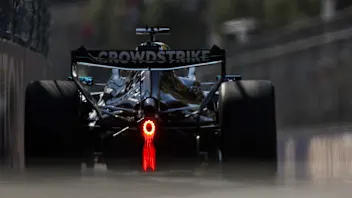
Example: “That flashing red light at the back of the car shows they're harvesting energy and recharging the battery.”
BLACK FLAG
Plain black flag shown to a driver (along with their car number) to signal that they have been disqualified. The driver must return to the pits immediately and is out of the race. A rare occurrence in F1.
Example: “That’s the black flag! They’ve been disqualified from the race!”
BLACK AND ORANGE FLAG
Black flag with an orange circle in the middle (sometimes nicknamed the ‘meatball flag’), shown to a driver (along with their car number) who has car damage or mechanical issues that could be dangerous to themselves or others. The driver must pit as soon as possible and fix the problem before they’re allowed to continue.
Example: “Part of that front wing looked loose, and now they’ve been shown the black and orange flag.”
BLACK AND WHITE FLAG
Diagonally-divided black and white flag shown to a driver (along with their car number) to warn them that any more unsporting behaviour will result in punishment. Repeatedly breaching track limits is an example of unsporting behaviour. Not to be confused with the chequered flag (which is also black and white).
Example: “They've been shown the black and white flag for exceeding track limits again and will need to be more careful now.”
BLISTERING
When heat from inside the tyre rises up to the cooler surface, creating small blisters and softening chunks of rubber that then fly off the tyre as it rotates (creating ‘marbles’). The resulting holes in the tyre surface reduce grip and can cause steering vibrations, forcing a driver to slow down to maintain control. Badly blistered tyres will need replacing during a pit stop.
Example: “I’ve got no grip at all! The tyres are blistering badly.”
BLUE FLAG
Plain blue flag shown to a driver to signal that they need to let a faster car behind them overtake as soon as possible. During a race, the blue flag is shown to backmarkers about to be lapped. During practice, the blue flag is shown to anyone when a much faster car is approaching. It is always shown to a driver rejoining from the pit lane when other cars on track are approaching at speed. A driver repeatedly ignoring a blue flag risks being penalised.
Example: “They’ve ignored three separate blue flags and failed to move over, and now they’ll be in trouble.”
BODYWORK
Parts fitted to the outside of the car, such as the engine cover, sidepods, and nosecone – usually made of carbon fibre composites. The bodywork is, more often than not, aerodynamically designed.
Example: “A piece of bodywork looks to have come off the car! Will that have an impact on their lap times?”
BOOST
Power unit mode giving a driver maximum power from the engine and battery at the push of a button, so long as there’s enough charge in their battery. Introduced as part of the 2026 regulations.
Example: “They're using Boost Mode and giving it absolutely everything!”
BOTTOMING
When the underside, or bottom, of the car hits the track surface, usually resulting in a spectacular shower of sparks. Certain set-ups can result in it happening more regularly because the car is lower to the ground. Also known as grounding.
Example: “The car was bottoming out a lot on the straights.”
BOX
Common name for the pit box – the area outside of a team’s garage in the pit lane. Use of the word box comes from the German Boxenstopp (meaning pit stop) and is easier to hear over the radio than the word pit, so teams use it to instruct a driver when it’s time for them to come in for a pit stop.
Example: “Box, Box, Box! Box this lap for fresh tyres.”
BRAKE BALANCE
Amount of braking power that's split between the front and rear of the car. The driver can adjust this balance while driving, enabling them to alter the car’s handling during a race without needing to stop. Also called brake bias.
Example: “I moved the brake balance towards the rear to try and stop the fronts from locking up.”
BRAKE-BY-WIRE
Electronic system connected to the rear brakes, alongside the hydraulic braking system. Part of the Energy Recovery System – electrical energy is recovered when braking and stored for use later.
Example: “There was an issue with the car, and I had no brake-by wire for the last few laps.”
BRAKING POINT
Point on the circuit before a corner where a driver hits the brakes to slow the car down before making the turn. Braking later than another driver can help with overtaking, but is risky as the car could be travelling too fast to make the corner!
Example: “I missed the braking point, carried too much speed into the corner, and ran wide.”
CAMBER
Angle that a tyre leans into or away from the car that affects how it contacts the track surface. This can impact grip, handling and tyre wear. If the top of the tyre angles towards the car, that’s negative camber. If the top of the tyre angles away from the car, that’s positive camber. A perfectly vertical tyre is neutral camber.
Example: “The front wheels on an F1 car are usually in negative camber to help with cornering.”
CARBON FIBRE
Common name for the carbon fibre-reinforced composite materials used in F1. Super strong and unbelievably lightweight with a very high-temperature tolerance, it’s incredibly useful in Formula 1 cars.
Example: “Carbon fibre is an amazing material for both performance and safety.”
CFD
Computational Fluid Dynamics. Complex simulations and analysis needing powerful computers to estimate aerodynamic airflow and car performance. Alongside wind tunnel testing, F1 teams have a restricted number of CFD hours they can use for car development based on where they finished the previous season.
Example: “Lots of ideas were looked at using CFD before several were then tested in the wind tunnel.”
CHASSIS
Main body of the F1 car onto which everything else is built or attached. Modern F1 chassis have incredibly strong carbon fibre boxes in which the driver sits, acting as survival cells to help protect them in the event of a crash. Also known as a monocoque (French for 'single shell'), and sometimes nicknamed a 'tub'.
Example: “That was a big impact, but it looks like the chassis has done its job.”
CHEQUERED FLAG
Black and white chequered-pattern flag waved to signal the end of the session. It is waved from the pit wall above the finish line until all cars still competing have passed it. Not to be confused with the black and white flag.
Example: “There’s the chequered flag and that’s a sensational race win!”
CHICANE
Tight sequence of corners in alternating directions. Designed to challenge drivers and slow the cars down at necessary points on the circuit – often creating good overtaking opportunities. The Nouvelle Chicane after the famous tunnel in Monaco is a good example.
Example: “They got the braking wrong, locked up, and completely cut the chicane.”
CIRCUIT
Motor racing track. A street circuit is made up of public roads, in a city or park, that have been temporarily closed to host a race – think Las Vegas, Monaco or Singapore. Other circuits are purpose-built venues designed specifically for motorsport, like Circuit of The Americas, Shanghai International Circuit or Suzuka Circuit.
Example: “As a rookie, this is the first time I’ve ever raced at this circuit in an F1 car.”
CLEAN AIR
Airflow ahead of a car that has not been disrupted (for example, by another car passing through it), allowing the optimal flow of air over the car needed to generate the right aerodynamic downforce. The opposite of 'dirty' air.
Example: “When I got past and into clean air, I was able to put in some decent laps.”
COANDA EFFECT
Tendency for airflow (or a fluid) to follow the contours of a solid surface as it moves over it rather than in a straight line. F1 aerodynamicists use the effect to help channel airflow around the car.
Example: “The Coanda effect is important to consider when trying to maximise the aerodynamic efficiency of the car.”
COCKPIT
Area within the chassis that the driver sits. F1 drivers are sometimes referred to as pilots, from the French word for driver, and there’s plenty of similarities between F1 cars and aircraft!
Example: “They’re just going through some final checks in the garage before climbing into the cockpit.”
COLD TYRES
Tyres that have not reached their optimum temperature – they’re not actually cold. F1 tyres perform best when they’re in the right 'temperature window’. Too cold and they won’t grip the track surface like they should. Too hot and they’ll degrade quicker than wanted (and then won’t grip like they should). Managing tyre temperatures is important in F1.
Example: “I’d just come out of the pits on cold tyres, so the grip level just wasn’t there.”
COMPOUND
Composition of the rubber materials used to make F1 tyres. Pirelli, as Global Tyre Partner of Formula 1, have six dry-weather tyre compounds in their range – C1, C2, C3, C4, C5 and C6 – and two wet-weather compounds – intermediate and full wet. The higher the compound number, the softer (and less durable) the tyre. The softer the tyre the faster the lap, as they provide more grip. Pirelli choose three compounds to become the hard, medium and soft tyres for every race weekend, depending on the circuit characteristics.
Example: “The C3 compound was the medium tyre last time F1 was here, but it’s the soft tyre this weekend.”
CONCORDE AGREEMENT
Contract between Formula 1, the FIA (as governing body) and the F1 teams that stipulates, amongst other things, how the sport is run and how prize money and revenues are distributed. Every team must sign the agreement to compete in Formula 1. It’s named after the Place de la Concorde in Paris, where discussions took place ahead of the first agreement being signed in 1981.
Example: “The Concorde Agreement has had multiple editions and renegotiations as the sport has evolved.”
CONSTRUCTOR
Official term for a Formula 1 team. Each team is required to design and build its own car, and so each team competes for the World Constructors' Championship every season.
Example: “Ferrari is the most successful constructor in F1 history.”
CONTROL ELECTRONICS
Standardised part of the F1 power unit that controls many systems on the car, making millions of calculations every second – playing a key role in converting electrical energy for storage or deployment. Drivers are allocated a specific number of control electronics units per season and will receive a penalty if this is exceeded.
Example: “They’ve had to replace the control electronics in the car ahead of this session.”
COOLDOWN LAP
Lap driven at a slower pace, usually after a 'flying' lap in Qualifying, to help bring temperatures down (engine or tyre temperatures, for example) while the car isn’t being driven as hard. F1 cars have impressive heat tolerances but perform best when they’re at the right temperature.
Example: “There were a lot of cars out on cooldown laps getting in the way while I was trying to push on my flying lap.”
COOLDOWN ROOM
Dedicated space in the paddock for drivers to recover and refresh themselves after a race before heading out to the podium.
Example: “Let’s try and listen in to what the drivers are saying in the cooldown room.”
CURFEW
Mandatory overnight periods during a race weekend when teams are not allowed to physically work on their cars, and the team members who normally would are required to leave the paddock. Each team gets two exceptions per season.
Example: “The team needed to use one of their curfew exceptions to repair the car overnight.”
DEBRIEF
Team meeting after a session to review performance and discuss car set-up and strategy.
Example: “There’s going to be a lot to discuss in the debrief after that session.”
DEGRADATION
Wearing down of parts, causing a reduction in performance. Tyres becoming worn out and losing their grip is the most obvious example, but all components degrade with use over time. Often shortened to ‘deg’.
Example: “We’re seeing a lot more tyre degradation than expected, so take it easy out there.”
DELTA
Difference between times. If a driver is faster than the time set, this is a negative delta and the time difference is shown with a minus symbol (e.g. -0.2s). If they are slower, that is a positive delta and the time difference is displayed with a plus symbol (e.g. +0.2s).
Example: “Keep an eye on your delta with the Virtual Safety Car.”
DERATING
Reduction in the amount of power produced by the power unit, specifically because the hybrid electrical elements run out of the electrical energy used to boost it.
Example: “It looks like we lost time on the long straights because of derating.”
DEVELOPMENT DRIVER
Driver employed by an F1 team whose primary focus is to help develop the car. This usually involves spending time in the team’s simulator, rather than in the car itself, because testing time on track in F1 is limited.
Example: “Our development driver has tested numerous set-ups in the simulator back at the factory.”
DIFFERENTIAL
Car part used to control the amount of power going to each of the rear wheels. When cornering, the outer rear wheel will need to rotate more than the inner rear wheel, and the ‘diff’ splits the drive to each wheel accordingly.
Example: “There seemed to be a problem with the differential that cost us a few tenths per lap.”
DIFFUSER
Rear section of the car's floor. As the car moves forward, the airflow underneath exits here and the diffuser design is important to control the speed at which it does. The faster the airflow exits, the lower the air pressure beneath the car – which generates more downforce.
Example: “All the talk in the paddock this morning has been about the team’s new diffuser.”
DIRTY AIR
Airflow in front of the car that has been disrupted – usually by a car ahead passing through it. F1 cars are designed to run best in ‘clean' air, so this turbulent air reduces aerodynamic downforce because it doesn’t flow smoothly over the car.
Example: “I was stuck in dirty air for so long, I just couldn’t get past.”
DNF
Did Not Finish. Race classification for a driver who fails to finish a race. If a driver has completed at least 90% of the race distance they are classified as finishing – even if they then retire before it officially ends.
Example: “The team suffered a disappointing double DNF last weekend.”
DNQ
Did Not Qualify. Race classification for a driver who fails to qualify for a race. To qualify, a driver needs to set a lap time in the first part of Qualifying that’s within 107% of the fastest time set (unless the track is officially declared wet).
Example: “Having set a good enough time in practice, the stewards have ruled the driver can start from the back despite their DNQ yesterday.”
DNS
Did Not Start. Race classification for a driver who successfully qualifies for a race but is then unable to take the start (because of a mechanical problem, for example).
Example: “It looks like it's going to be an unfortunate DNS as the team have been unable to fix the car in time for the race.”
DOUBLE STACK
When both cars in a team make a pit stop at the same time (well, one immediately after the other). It can be risky, but if executed perfectly the first car will be leaving the pit box just as the second car arrives for its stop.
Example: “They’re double stacking here… and they’ve done it perfectly!”
DOWNFORCE
Force that acts vertically on the car as a result of aerodynamics. The car gets pushed down onto the track surface as air flows over it (or sucked down into the surface as air flows under it). Downforce can improve grip, traction, and handling – enabling a driver to go faster around corners.
Example: “The low downforce set up means the car will slide more when cornering but go faster on the straights as there'll be less drag.”
DRAG
Force that acts horizontally on the car in the opposite direction to its movement as a result of aerodynamics. Too much drag on the car as it moves through the air will slow it down. Also known as air resistance.
Example: “The car had so much drag that it felt like I was towing a parachute behind me on the main straight.”
DRIFT
Driving technique that slides the car sideways around a corner while maintaining control. Drifting is slower than taking the normal racing line, so it’s most often seen in F1 when a driver is pushing hard and fighting to keep control.
Example: “They’ve done brilliantly well to keep control of that car with a small drift through the corner.”
DRIVE TO SURVIVE
Popular documentary series produced between F1 and Netflix that goes behind-the-scenes of the sport. Officially titled Formula 1: Drive to Survive.
Example: “Anyone who’s seen Drive to Survive will know exactly what that means!”
DRIVE-THROUGH PENALTY
Penalty handed to a driver by the stewards during a race. Drivers must drive through the pit lane without stopping – obeying the speed limit throughout – before re-joining the race.
Example: “They’ve been given a drive-through penalty for that earlier incident.”
DRIVERS' BRIEFING
Meeting of all the drivers and the FIA Race Director during a race weekend, primarily to discuss issues relating to that Grand Prix. Other subjects, such as driving standards or safety, may also be discussed.
Example: “Apparently the topic was discussed in detail at the drivers’ briefing this weekend.”
DRIVERS’ PARADE
Processional lap around the circuit two hours before the Grand Prix start that all the drivers take part in – more often than not in classic open-top cars.
Example: “The crowd absolutely loved seeing their heroes earlier today on the drivers’ parade.”
DRS
Drag Reduction System, used previously in Formula 1. A driver could open a flap on the car’s rear wing at certain parts of the circuit (usually long straights) known as DRS zones. This reduced aerodynamic drag on the car, allowing it to move faster, which helped with overtaking. During a race, DRS could only be used if a car was less than one second behind the car in front as it crossed a DRS detection point. DRS was not available in wet conditions. It was replaced by 'Active Aero' and 'Overtake Mode' as part of the 2026 regulations.
Example: “DRS use during a Grand Prix was restricted, but the Active Aero system is useable by all of the cars, all of the time.”
DSQ
Disqualified. Session classification when a driver is disqualified for breaking the rules.
Example: “It’s not often you see DSQ on the timesheet!”
ECU
Electronic Control Unit. Standardised programmable unit installed inside a car, connected to more than 100 sensors. That data is transmitted to the team in real time, allowing them to make rapid data-based decisions – such as changes to race strategy.
Example: “The ECU is manufactured by an FIA designated supplier.”
ENDPLATE
Vertical bodywork pieces on (or near) the outside edges of the front and rear wings. Key parts of the car’s aerodynamic design.
Example: “The damage to the front wing endplate after that earlier collision is having an impact on performance.”
ENERGY STORE
Rechargeable electrical storage unit used in F1’s hybrid power units since 2014. More commonly called the battery. Drivers are allocated a specific number of energy stores per season and will receive a penalty if this is exceeded.
Example: “The energy store is fully charged – deploy as you need to on this lap.”
ERS
Energy Recovery System. Components working together to recover energy from the car, convert and store it as electrical energy, and then make it available to deploy. The Motor Generator Unit – Kinetic (MGU-K), energy store and control electronics are key parts of the ERS.
Example: “I’m down on battery power! Is there a problem with the ERS?”
ESSES
When a corner turning left is followed shortly afterwards by a corner turning right (or vice versa) – so that together they look like a bit like the letter ‘S’. Think the Senna Esses at Interlagos. If such corners follow each other immediately, that’s a chicane.
Example: “Some say the high-speed esses at Suzuka are the most awesome sequence of bends on the F1 calendar.”
Next Up
Related Articles
 Williams eye Baku boost as every team's upgrades revealed
 Lawson returns as Lindblad hits trouble in Baku
 BettingBest value early bets for the Azerbaijan Grand Prix
 Practice running in Baku 'was a good recovery' – Antonelli
 Cadillac recruit technical leaders from Red Bull and Ferrari
 BettingLatest Azerbaijan GP odds before Qualifying in Baku